
How Much Life Insurance Do You Need?
Introduction
One of the most common questions we hear at Session & Coker Insurance Services LLC is: "How much life insurance do I actually need?" It's a fair question — and the honest answer is that it depends on your personal situation. But the good news is that with a few key calculations and a clear understanding of your goals, you can arrive at a coverage amount that truly protects your family.
Life insurance is not just for the elderly or those with serious health conditions. It's one of the most powerful financial tools available to working adults, parents, and business owners at any age. This guide will walk you through the key factors, formulas, and life stages that determine how much coverage is right for you.
⚠️ Why This Matters
According to insurance industry research, the majority of American households are underinsured. Many people either have no life insurance or have coverage amounts far below what their families would actually need to maintain their standard of living. Don't let your family be left vulnerable.
What Is Life Insurance and Why Do You Need It?
Life insurance is a contract between you and an insurance company: in exchange for regular premium payments, the insurer agrees to pay a lump sum — called a death benefit — to your designated beneficiaries when you pass away.
This death benefit can be used for virtually anything your beneficiaries need, including:
•Replacing your income so your spouse or partner can maintain their lifestyle
•Paying off the mortgage so your family doesn't lose the home
•Covering your children's education costs
•Paying off outstanding debts (car loans, credit cards, student loans)
•Covering final expenses such as funeral and burial costs (average $8,000–$12,000)
•Funding a business succession plan if you're a small business owner
The Two Main Types of Life Insurance
Term Life Insurance
Term life provides coverage for a specific period — typically 10, 20, or 30 years. If you pass away during the term, your beneficiaries receive the death benefit. If you outlive the term, coverage ends (though many policies can be renewed or converted).
Best for: Young families, parents with young children, those with a mortgage, anyone who wants maximum coverage at the lowest cost.
Permanent Life Insurance (Whole or Universal Life)
Permanent life insurance covers you for your entire life, as long as premiums are paid. It also builds cash value over time that you can borrow against. Premiums are higher than term, but coverage never expires.
Best for: Estate planning, those who want lifelong coverage, business owners, individuals who've maxed out other retirement savings vehicles.
💡 Session & Coker Insight
Most families benefit from a combination approach: a large term life policy for income replacement during the peak earning and child-raising years, plus a smaller permanent policy for lifelong protection and estate planning purposes.
How to Calculate How Much Life Insurance You Need
There are several methods used to estimate the right coverage amount. Here are the most widely recommended approaches:
Method 1: The DIME Formula
DIME stands for Debt, Income, Mortgage, and Education — the four biggest financial obligations your family would face without you.
•Debt: Total all personal debts (credit cards, car loans, student loans, etc.)
•Income: Multiply your annual income by the number of years your family needs support (often 10–15 years)
•Mortgage: Add your remaining mortgage balance
•Education: Estimate future college or education costs for each child
Add these four figures together for your recommended coverage floor.
Method 2: Income Replacement (10x Rule)
A simpler rule of thumb: multiply your annual income by 10. This gives a rough estimate of what it would take to replace your earnings for a decade — enough time for your family to adjust financially. Some experts recommend 12x or even 15x for younger families with greater long-term needs.
Method 3: Human Life Value
This method calculates the present value of your expected future earnings — essentially, what your income stream is worth from today until retirement. This tends to produce higher coverage estimates and is often used by financial planners and business owners.
📊 Quick Example: The DIME Formula in Action
Sample Profile: Married, two children (ages 5 and 8), annual income $65,000.Debt: $20,000 (car loan + credit cards) Income: $65,000 x 15 years = $975,000 Mortgage: $185,000 remaining balance Education: $50,000 per child x 2 = $100,000Total Recommended Coverage: $1,280,000 — A 20-year term life policy at this level could cost as little as $50–$70/month for a healthy adult in their 30s.
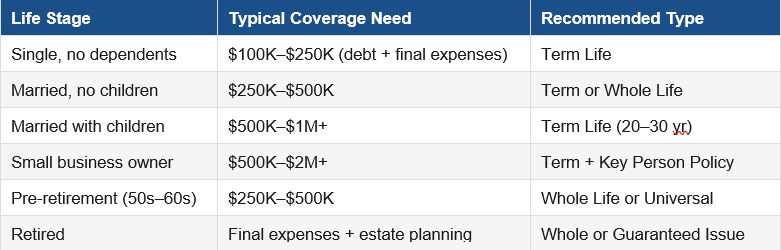
Life Insurance Needs by Life Stage
Your insurance needs evolve as your life changes. Here's a general guide by life stage:
Factors That Affect Your Life Insurance Premium
Several factors determine how much you'll pay for a life insurance policy:
•Age — younger applicants receive significantly lower rates
•Health — a medical exam is typically required for larger policies; pre-existing conditions affect pricing
•Gender — statistically, women live longer and often pay less for life insurance
•Coverage amount — higher death benefits mean higher premiums
•Policy type — term is less expensive than permanent coverage
•Lifestyle — smokers pay substantially more; extreme sports participants may also face higher rates
•Occupation — high-risk jobs can increase premiums
The most important takeaway: buy life insurance as early as possible. Every year you wait, premiums increase. A policy purchased in your 30s will almost always be far less expensive than the same coverage purchased in your 40s or 50s.
Common Life Insurance Mistakes to Avoid
1. Relying Only on Employer-Provided Coverage
Most employer group life insurance policies provide coverage equal to 1–2x your annual salary — far below what most families actually need. And if you leave your job, that coverage disappears. Employer coverage is a supplement, not a substitute.
2. Choosing Too Short a Term
A 10-year term may seem adequate now, but what if your mortgage still has 25 years to go? Match your term length to your longest financial obligation.
3. Not Naming a Beneficiary (or Not Updating It)
Life changes. Divorce, remarriage, births, and deaths all affect who should receive your death benefit. Review your beneficiary designations every few years.
4. Waiting Until You're Older or Sick
Life insurance becomes dramatically more expensive — or unavailable — once health issues emerge. The best time to buy is when you're young and healthy.
More Resources for Sumter Residents
Explore these related topics on our website:
•Best Car Insurance in Sumter, SC — What Local Drivers Need to Know
•Home Insurance Guide for First-Time Homeowners in South Carolina
•Insurance Coverage for Small Businesses — Protecting What You've Built
•How to Lower Your Insurance Premiums Without Sacrificing Coverage
Visit www.ernestsession.com to learn more or schedule a consultation.
Frequently Asked Questions About Life Insurance
Q: How much life insurance does the average person need?
A: Most financial experts recommend coverage equal to 10–12 times your annual income, though the exact amount depends on your debts, dependents, mortgage, and financial goals. Use the DIME formula for a more precise estimate, or speak with one of our licensed agents for a personalized recommendation.
Q: Is term or whole life insurance better?
A: It depends on your goals. Term life is less expensive and ideal for income replacement during your working years. Whole life offers permanent coverage and cash value accumulation, making it useful for estate planning and lifelong protection. Many people benefit from a combination of both.
Q: Can I get life insurance if I have health problems?
A: Yes, in many cases. Guaranteed issue and simplified issue policies are available for those with health conditions, though they typically come with lower coverage limits and higher premiums. Our agents can help you find coverage options that work for your situation.
Q: How much does life insurance cost per month?
A: A healthy 35-year-old can often get a 20-year, $500,000 term life policy for $25–$40 per month. Costs vary based on age, health, coverage amount, and policy type. The best way to know your rate is to get a personalized quote.
Q: When should I review my life insurance coverage?
A: Review your policy after any major life event: marriage, divorce, birth of a child, home purchase, significant income change, or starting a business. A quick annual review with your insurance agent ensures your coverage stays aligned with your current needs.
Take the Next Step — Protect Your Family Today
Get Your Life Insurance Quote Today
Our licensed agents at Session & Coker Insurance Services LLC will help you find the right coverage amount and policy type — tailored to your life stage, budget, and goals.
📞 Call Us Today|🌐 www.ernestsession.com
Protecting Sumter Families — One Policy at a Time.
Session & Coker Insurance Services LLC•Sumter, SC•www.ernestsession.com
Licensed Independent Insurance Agency — Life, Auto, Home, and Business Insurance
